


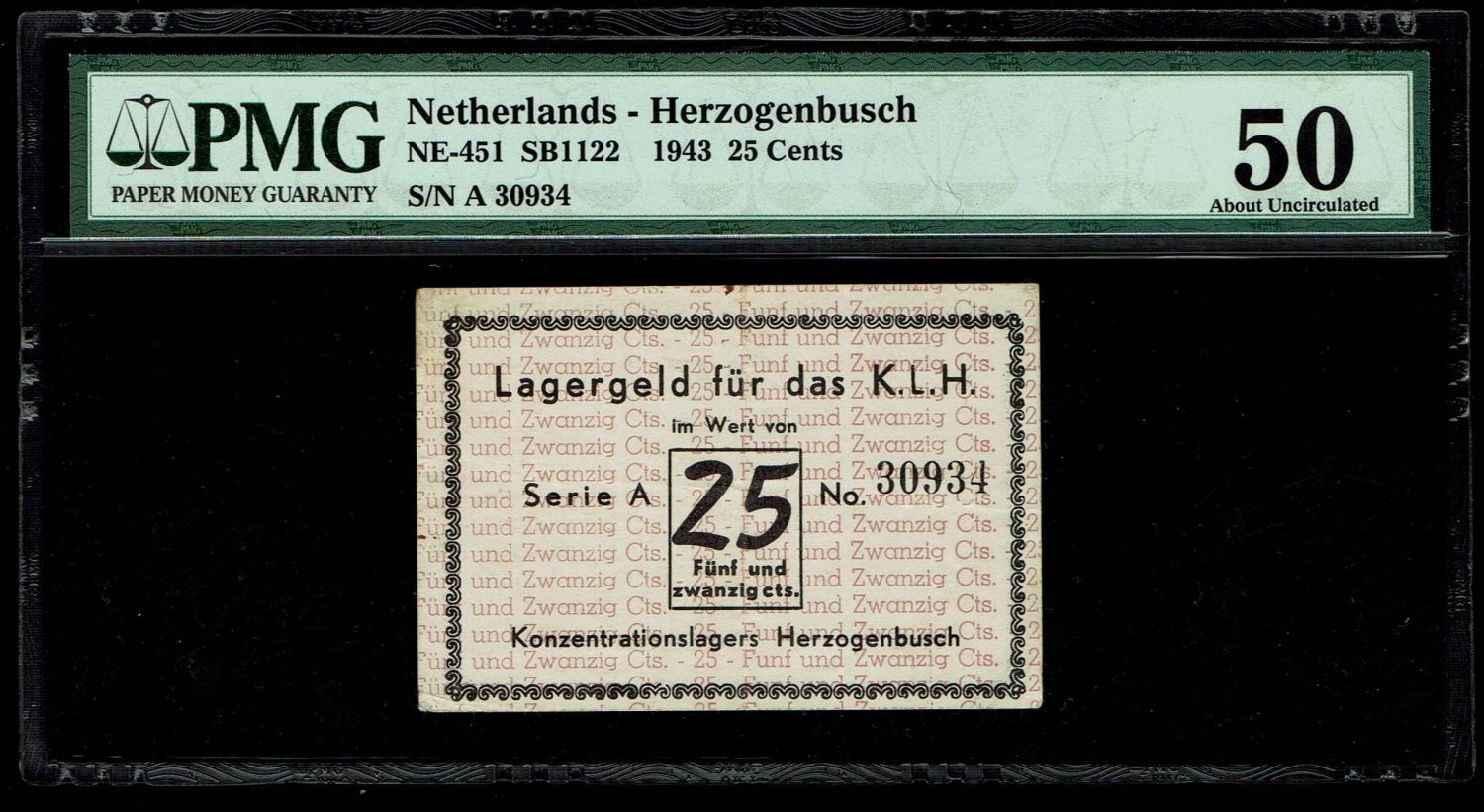
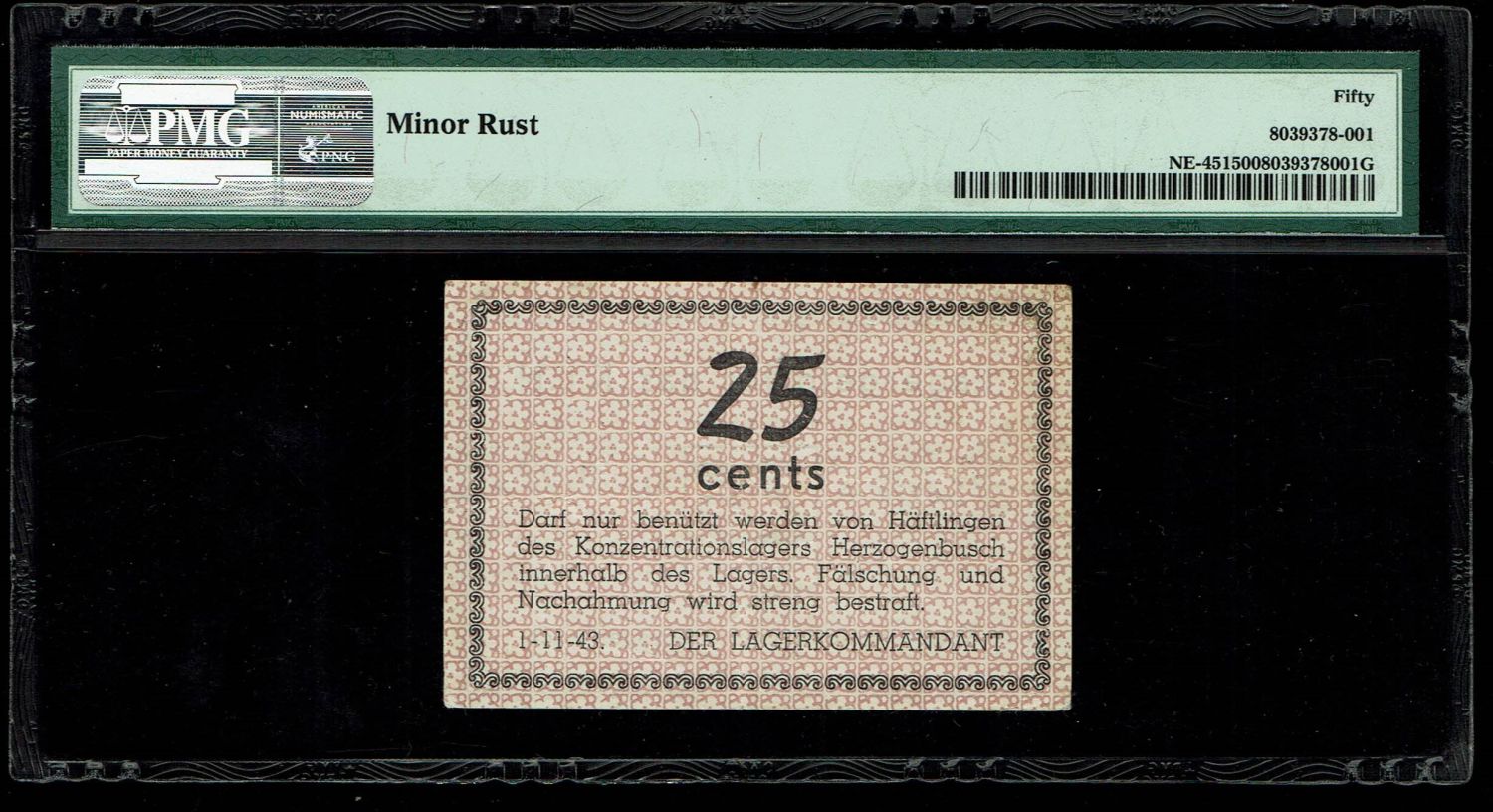
Holocaust concentration camps money - Netherlands, Camp Herzogenbusch - 25 cents 1943 - PMG 50
Holocaust concentration camps money - Netherlands, Camp Herzogenbusch - 25 cents 1943 - PMG 50 Camp Ficht (in Dutch: Kamp Vught, in German: KZ Herzogenbusch after the nearby city of Hertogenbusch) was one of the five concentration camps that operated in the Netherlands during World War II. Construction of the camp began in 1942, and it was built in a format similar to the German concentration camps. When the first prisoners arrived from the Amerspoort camp, the camp was not yet ready, and they were forced to build it themselves. The camp was opened on January 5, 1943 under the command of SS-Untersturmführer Karl Kamilevsky. In total, about 31,000 prisoners were imprisoned in the camp, including 15,000 Jews and the rest political prisoners, gypsies, underground fighters, vagabonds, criminals, black market traders and more. At least 749 people are known to have died in the camp, and 329 of them were executed at an execution site near the camp. About 12,000 Jewish prisoners passed through the camp on their way to extermination camps in Poland. Most of the prisoners were Dutch, among them the Righteous Among the Nations and the Dutch underground activist Jan Sahep, and some of them were Belgians. The camp had workshops of the Philips company and the prisoners worked in them as forced labor. In any case, the company's management tried to ease the working conditions there, and managed to convince the Nazi commanders to allow the prisoners more frequent breaks. It also provided the prisoners with extra food, clothing and even music that was played in the camp, and the members of the company protected the workers (called "Phillips-Commando") from the harassment of the Capuas. On June 5, 1943, it was learned that all the Jewish children in the camp had to leave the camp, apparently to live in a special children's camp nearby. In fact, the children were sent to the Westerbork concentration camp and from there to Sobibor, where they were all murdered. After several women in the camp protested the harsh conditions, SS-Hauptsturmführer Adam Grünewald, who had been commandant of the camp since October 1943, ordered 74 women to be imprisoned in cell number 115 for fourteen hours. The area of the cell was nine square meters, and it had no openings for ventilation. Ten women were killed this way. When news of this reached the Dutch press, Greenwald was tried by the SS and sentenced to 15 years in prison, but his sentence was commuted: he was demoted and stationed on the Eastern Front, where he was killed in battle. Next to Khmelevsky (who was convicted by the Nazis of abusing prisoners and stealing diamonds, and ended up imprisoned by the Nazis in the Dachau camp) he is one of the few - only a few hundred of the entire camp staff - who stood trial in Nazi Germany for violating orders that resulted in the death of prisoners. Starting in February 1944, he was replaced as SS-Untersturmführer Hans Hittig, until the camp was evacuated in September of that year. During this period Hittig ordered the execution of 329 prisoners. On September 5 and 6, 1944, the Germans evacuated the camp in view of the Allied advance, and the prisoners were sent to Sachsenhausen. On October 26, 1944, the 4th Canadian Armored Division liberated the camp, after a battle with an SS guard unit that was left to guard the almost completely evacuated camp. At that time, there were about 500-600 surviving prisoners left in the camp, and they were left to be executed that afternoon. About 500 bodies of prisoners were discovered in piles near the gates, after they were murdered in the morning of the day the camp was liberated.
 Israel
 הביטחון 6, פתח תקווה.
