


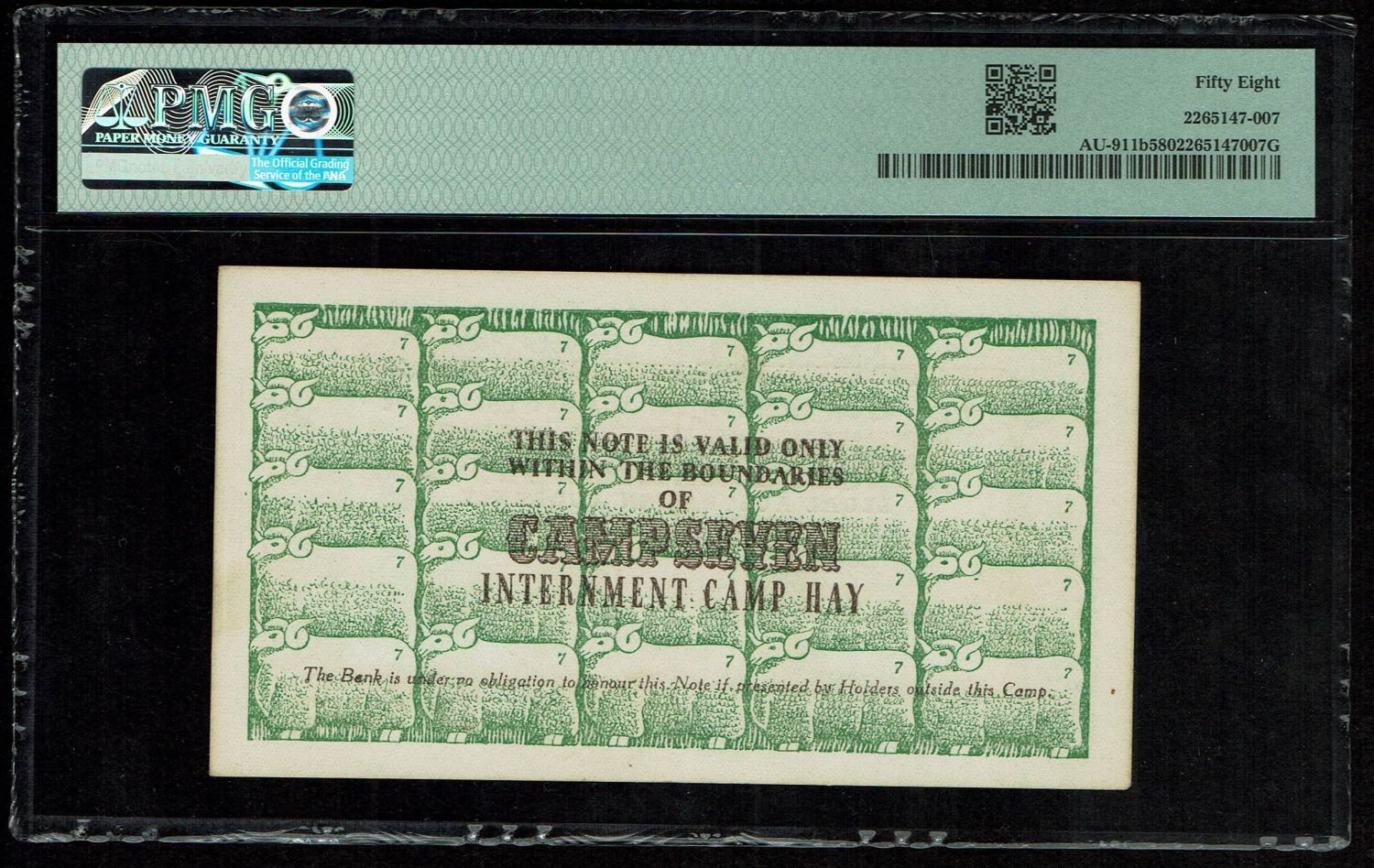
Holocaust concentration camps money - Australia, Hay camp - for a total of 1 Shilling - PMG 58 - Very Rare
Holocaust concentration camps money - Australia, Hay camp - for a total of 1 Shilling - PMG 58 - Very Rare A total of 173 notes are knowned from all of the values were reported by Bullus in The Hay Internment Camp Notes published in 1994. The Hay Internment and POW camps at Hay, New South Wales, Australia were established during World War II as prisoner-of-war and internment centres, due in no small measure to the isolated location of the town. Three high-security camps were constructed in 1940. The first arrivals were over two thousand refugees from Nazi Germany and Austria, most of whom were Jewish; they had been interned in the United Kingdom when fears of an armed invasion of Britain were at their peak. The British government then forcibly transported these refugees to Australia on the HMT Dunera. The internees were kept in conditions on board the Dunera that were cruel and inhumane, and after the war the Dunera story became quite infamous, leading the British government to apologise for their egregious mistreatment of innocent civilian refugees. Hay was the commercial center of a sheep grazing area along the Murrumbidgee River. The new Camp Hay had been constructed in a town with fewer than 3,000 people Fifty-four percent of the internees were between seventeen and thirty. The vast majority, 747 men, were Jewish. The remainder included 89 Protestants, 55 Catholics, 19 members of the Church of England, 1 Methodist, and 11 men who did not specify a denomination. 577 men came from Germany and 239 came from Austria. Along with developing a cultural life, the internees were worried about how they could work in the camp. To this end, many jobs started up at the camp. Jobs in Camp Hay were paid according to how hard the work was. At first, cigarettes were the official economy of Camp Hay, and wages were paid accordingly. Originally, the camp leaders wanted to use a photograph of a local scene on the notes. The printer, Gavin Johnston, worked for a local paper called the Riverine Grazier. Johnston explained that a photograph would not show up well with the low quality paper and equipment he had. He advised the camp leaders to find an artist who could prepare an original drawing. A. Teltscher, who had experience as an artist and engraver, was chosen as the designer . Teltscher was born to a Jewish family of Austrian artists. His first experience with designing money was through his aunt, who was a coinage designer. The most powerful difference between the Camp Hay issues and the money from concentration camps and ghettos is the use of humor. The men behind the money from German camps were surrounded by horrors and despair, as well as the constant threat of death. Although the Camp Hay notes reflect on the prisoners’ feelings of frustration, they also show the relative freedom within Camp Hay, as compared to internment under the Nazis. The notes are also, at first glance, secular. They have none of the overt symbols of Judaism that the ghetto issues had. This reflects the change in circumstance from German rule to British rule. Although the terms of their imprisonment still felt unfair, the reason was no longer a religious one. The Camp Hay notes reflect the absurdity of their imprisonment, but they do so through Teltscher’s wit and clever use of symbolism. The most powerful difference between the Camp Hay issues and the money from concentration camps and ghettos is the use of humor. The men behind the money from German camps were surrounded by horrors and despair, as well as the constant threat of death. Although the Camp Hay notes reflect on the prisoners’ feelings of frustration, they also show the relative freedom within Camp Hay, as compared to internment under the Nazis. The notes are also, at first glance, secular. They have none of the overt symbols of Judaism that the ghetto issues had. This reflects the change in circumstance from German rule to British rule. Although the terms of their imprisonment still felt unfair, the reason was no longer a religious one. The Camp Hay notes reflect the absurdity of their imprisonment, but they do so through Teltscher’s wit and clever use of symbolism. Branding the sheep shows Camp Hay’s control over the men. Each sheep has a unique face, and the sheep also have names hidden in their wool. The names Teltscher placed on the sheep were all prominent members of the camp. However, it is again necessary to wonder why sheep were chosen to represent the internees. The obvious allegory would be that the men were forced to act as sheep, being herded into the camp and completely without control.
 Israel
 הביטחון 6, פתח תקווה.
